AI and Blockchain in Agriculture: The $1 Trillion Farming Revolution Transforming Food, Trust, and Profits in 2026.

Table of Contents
Introduction
Agriculture is entering a new era—one defined not just by machinery and labor, but by data, intelligence, and transparency. The convergence of artificial intelligence and blockchain technology is reshaping how food is produced, tracked, and traded across the globe. What was once a traditional industry is now becoming a high-tech ecosystem driven by predictive analytics and decentralized systems.
AI and blockchain in agriculture are no longer futuristic concepts. They are already being implemented to solve some of the industry’s biggest challenges: inefficiency, lack of transparency, climate risks, and supply chain complexity. Technology leaders like IBM and Microsoft are actively developing solutions that combine AI-driven insights with blockchain’s secure data infrastructure.
This transformation is not just about innovation—it is about survival. As global food demand increases and climate conditions become more unpredictable, farmers and agribusinesses must adopt smarter, more resilient systems. In this article, we explore how AI and blockchain in agriculture are driving a revolution that could redefine farming as we know it.
What Are AI and Blockchain in Agriculture?
AI and blockchain in agriculture refer to the integration of two powerful technologies:
- Artificial intelligence analyzes data to improve decision-making
- Blockchain records and secures transactions in a transparent, tamper-proof system
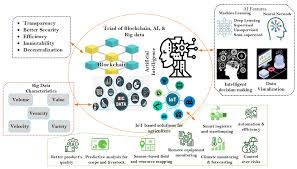
Together, AI and blockchain in agriculture create a system where data is not only intelligent but also trustworthy. This combination allows farmers, suppliers, and consumers to access accurate, real-time information about agricultural processes.
Why Agriculture Needs AI and Blockchain
Agriculture faces several critical challenges:
- Climate change affecting crop yields
- Lack of transparency in supply chains
- Inefficient resource usage
- Limited access to reliable market data
AI and blockchain in agriculture address these issues by providing:
- Predictive insights for better planning
- Transparent tracking of products
- Efficient resource management
- Secure and reliable data sharing
This makes farming more sustainable, profitable, and resilient.
𝐀𝐥𝐬𝐨 𝐑𝐞𝐚𝐝 : https://www.datadriveharvest.com/2026/03/25/ai-carbon-farming/
How AI Is Transforming Agriculture
Predictive Analytics and Smart Farming
Artificial intelligence enables farmers to predict outcomes based on historical and real-time data. AI systems analyze weather patterns, soil conditions, and crop performance to recommend optimal farming practices.
This allows farmers to:
- Improve crop yields
- Reduce waste
- Minimize risks
Precision Agriculture
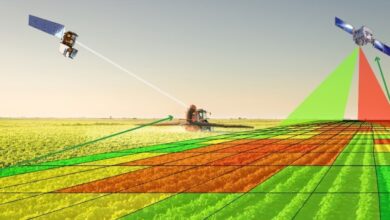
AI-powered precision agriculture ensures that resources such as water, fertilizers, and pesticides are used efficiently. By applying inputs only where needed, farmers can reduce costs and environmental impact.
Automation and Robotics
AI is driving automation in farming through:
- Autonomous tractors
- Drone-based crop monitoring
- Robotic harvesting systems
These technologies increase efficiency and reduce labor dependency.
How Blockchain Is Transforming Agriculture
Transparent Supply Chains
Blockchain technology creates a transparent and traceable supply chain. Every transaction—from farm to consumer—is recorded on a secure ledger.
This ensures:
- Food safety
- Product authenticity
- Reduced fraud
Smart Contracts
Blockchain enables smart contracts that automatically execute transactions when conditions are met. For example, farmers can receive payments instantly once products are delivered.
Data Security
Blockchain ensures that agricultural data is secure and cannot be altered. This builds trust among stakeholders and improves collaboration.
𝐉𝐨𝐢𝐧 𝐎𝐮𝐫 𝐖𝐡𝐚𝐭𝐬𝐀𝐩𝐩 𝐆𝐫𝐨𝐮𝐩 𝐟𝐨𝐫 𝐦𝐨𝐫𝐞 𝐔𝐩𝐝𝐚𝐭𝐞𝐬
The Power of Combining AI and Blockchain in Agriculture
When AI and blockchain in agriculture are combined, they create a powerful ecosystem:
- AI analyzes data and generates insights
- Blockchain ensures data integrity and transparency
This integration enables:
- Reliable decision-making
- Efficient supply chain management
- Enhanced trust between stakeholders
Real-World Applications
Crop Monitoring and Traceability
AI monitors crop health using satellite imagery and sensors, while blockchain records every stage of the production process. Consumers can trace food back to its origin.
Smart Irrigation Systems
AI optimizes water usage based on soil and weather data, while blockchain tracks water usage and ensures fair distribution.
Agricultural Finance
Blockchain provides secure platforms for financial transactions, while AI assesses credit risk. This improves access to funding for farmers.
𝐀𝐥𝐬𝐨 𝐑𝐞𝐚𝐝 : https://www.datadriveharvest.com/2026/03/18/crop-intelligence/
Benefits of AI and Blockchain in Agriculture
Increased Efficiency
AI and blockchain in agriculture streamline processes, reduce waste, and improve productivity.
Enhanced Transparency
Blockchain ensures that all transactions are visible and verifiable, increasing trust.
Improved Sustainability
AI optimizes resource usage, while blockchain promotes accountability, leading to more sustainable practices.
Better Market Access
Farmers can connect directly with buyers, reducing intermediaries and increasing profits.
Challenges and Limitations
Despite their benefits, AI and blockchain in agriculture face challenges:
- High implementation costs
- Limited technical expertise
- Infrastructure constraints in rural areas
- Regulatory uncertainties
Overcoming these challenges will require collaboration between governments, technology providers, and farmers.
AI and Blockchain in Agriculture in Africa
Africa has a unique opportunity to leverage AI and blockchain in agriculture to transform its farming sector. With increasing mobile connectivity and digital adoption, the continent can implement innovative solutions tailored to local needs.
Countries like Kenya and South Africa are already exploring digital agriculture technologies.
Opportunities for Africa
- Improving food security
- Enhancing supply chain transparency
- Increasing farmer incomes
- Reducing post-harvest losses
AI and blockchain in agriculture can help Africa leapfrog traditional systems and build a modern, resilient agricultural sector.
The Future of AI and Blockchain in Agriculture
The future of AI and blockchain in agriculture is promising, with several trends shaping the industry:
Integration with IoT
The Internet of Things (IoT) will provide more data for AI analysis and blockchain recording.
Expansion of Digital Platforms
More platforms will emerge to connect farmers, buyers, and financial institutions.
Increased Adoption
As technology becomes more affordable, more farmers will adopt AI and blockchain solutions.
Why This Matters Now
The global population is expected to reach nearly 10 billion by 2050. Meeting this demand requires a transformation in how food is produced and distributed.
AI and blockchain in agriculture offer a solution by:
- Increasing productivity
- Reducing waste
- Enhancing transparency
This makes them essential tools for the future of farming.
Conclusion
AI and blockchain in agriculture are revolutionizing the farming industry by combining intelligence with transparency. Technologies developed by companies like IBM and Microsoft are enabling farmers to make smarter decisions, improve efficiency, and build trust in the supply chain.
For regions like Africa, this transformation represents a significant opportunity to modernize agriculture and achieve sustainable growth. As adoption increases, AI and blockchain in agriculture will become fundamental to ensuring food security and economic development.
The future of farming is here—and it is intelligent, transparent, and powered by data.