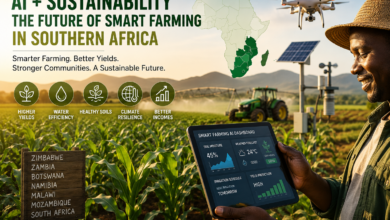
Discover 6 powerful AI trends transforming African agriculture in 2026, from predictive farming and smart irrigation to livestock monitoring, digital advisors and farm data.


Table of Contents
6 AI Trends Shaping the Future of African Agriculture in 2026
AI for African agriculture is entering an interesting new chapter.
For generations, farmers across the continent have relied on experience, local knowledge, weather patterns and careful observation to make decisions. That knowledge remains incredibly valuable.
But something new is being added to the farmer’s toolbox: artificial intelligence.
AI is increasingly being used to analyse weather information, identify crop diseases, monitor livestock, improve irrigation, predict yields and provide agricultural advice.
In January 2026, the Food and Agriculture Organization of the United Nations highlighted Artificial Intelligence applications already being promoted in Zimbabwe and across Africa, including climate prediction, pest surveillance, irrigation management, advisory services and food-safety systems.
The opportunity is significant, but Africa will not necessarily use of Artificial Intelligence in exactly the same way as large commercial farms in North America or Europe.
The continent needs solutions that are affordable, mobile-friendly, locally relevant and useful for smallholder farmers.
Here are six AI trends worth watching.
1. AI-Powered Farm Decision-Making Is Moving Closer to Farmers
One of the biggest changes can bring to agriculture is helping farmers make better decisions before problems become expensive.
Imagine a farmer receiving a simple message saying:
“Rain is expected later this week. Consider delaying fertilizer application.”
Or:
“Your crop images show possible signs of disease. Check the affected area and seek agricultural advice.”
This is where Artificial Intelligence becomes practical.
Instead of requiring farmers to understand complicated data dashboards, Artificial Intelligence can turn large amounts of information into simpler recommendations.
For Africa’s smallholder farmers, this could be especially valuable because decisions often have to be made with limited access to agricultural experts.
The future may therefore be less about farmers becoming data scientists and more about Artificial Intelligence becoming easier for farmers to use.
2. Predictive Agriculture Could Help Farmers Prepare Earlier
Traditional farming often involves reacting to problems.
A disease appears.
Rain doesn’t arrive.
A pest population suddenly increases.
A water source becomes insufficient.
AI offers another possibility: prediction.
Machine-learning systems can analyse historical weather information, satellite imagery, soil conditions and crop-development data to identify patterns.
This can help farmers and agricultural organisations estimate:
- Possible crop yields
- Weather-related risks
- Pest outbreaks
- Disease risks
- Water requirements
- Potential production problems
Satellite data and machine learning are already being explored for food-crop production across Africa, including applications involving maize, cassava, rice and wheat.
For farmers facing unpredictable seasons, earlier information can make a meaningful difference.
𝐀𝐥𝐬𝐨 𝐑𝐞𝐚𝐝: https://www.datadriveharvest.com/2026/06/15/precision-agriculture/
3. Smart Irrigation Will Become More Important
Water is one of Africa’s most valuable agricultural resources.
In some areas, farmers struggle with drought. In others, irrigation systems may use more water than necessary.
AI can help change this.
Smart irrigation systems can combine information such as:
- Soil moisture
- Weather forecasts
- Crop growth
- Temperature
- Humidity
- Satellite information
The system can then help determine when crops are likely to need water.
Instead of simply irrigating according to a fixed schedule, farmers can move towards data-driven irrigation.
This is particularly interesting for Africa because water efficiency is becoming increasingly important as farmers deal with climate variability.
AI does not have to replace traditional farming knowledge. Instead, it can help farmers combine their experience with additional information.
4. AI and Smartphones Could Transform Crop Disease Detection
You don’t always need an expensive machine to use Artificial Intelligence.
A smartphone could become an agricultural diagnostic tool.
A farmer takes a photograph of a damaged leaf, uploads it to an Artificial Intelligence -powered application and receives an indication of possible disease or pest damage.
This technology is particularly promising for regions where agricultural extension officers cannot reach every farmer quickly.
AI-based image recognition can help identify patterns that may not be immediately obvious to the human eye.
However, there is an important lesson here: Artificial Intelligence should support agricultural expertise, not replace it completely.
A farmer should not make major decisions about pesticides or other treatments based solely on an AI-generated diagnosis.
Local conditions, crop variety, disease severity and professional agricultural advice still matter.
5. AI Is Moving Into African Livestock Farming
AI in agriculture isn’t only about crops.
Livestock farming is another area where artificial intelligence could make a growing impact.
Artificial Intelligence , computer vision, sensors and Internet of Things technologies are being explored for:
- Animal health monitoring
- Disease surveillance
- Livestock identification
- Feed optimisation
- Reproductive management
- Poultry monitoring
- Dairy production
- Climate-risk management
𝐉𝐨𝐢𝐧 𝐎𝐮𝐫 𝐖𝐡𝐚𝐭𝐬𝐀𝐩𝐩 𝐆𝐫𝐨𝐮𝐩 𝐟𝐨𝐫 𝐌𝐨𝐫𝐞 𝐔𝐩𝐝𝐚𝐭𝐞𝐬
A 2026 review of Artificial Intelligence applications in African livestock production identified potential uses in animal-health diagnostics, disease surveillance, poultry monitoring, dairy and cattle management, feed optimisation and other areas.
This could be particularly useful for African livestock farmers who need affordable ways to monitor animals and identify health problems earlier.
The challenge will be making these systems suitable for African production environments rather than simply importing technologies designed for highly automated commercial farms.
6. Clean Agricultural Data Will Become a Competitive Advantage
This may be the least exciting trend to talk about, but it could be one of the most important.
Artificial Intelligence needs data.
If farm records are incomplete, inaccurate or inconsistent, Artificial Intelligence systems may produce poor recommendations.
As Artificial Intelligence tools expand, clean and reliable farm data becomes increasingly valuable.
For African agriculture, this creates a major opportunity.
Farmers, cooperatives, agribusinesses and governments can increasingly collect information about:
- Crop yields
- Soil conditions
- Weather
- Farm locations
- Livestock
- Input use
- Market prices
- Irrigation
- Pest outbreaks
When this information is collected responsibly and securely, it can become the foundation for better agricultural decision-making.
It can also help financial institutions, insurers, researchers and policymakers understand agricultural risks more accurately.
What Makes Artificial Intelligence in Africa Different?
There is a temptation to look at AI-powered farms in wealthy countries and assume Africa simply needs to copy the same model.
That may not work.
Africa has its own agricultural realities.
Many farmers operate small plots.
Internet connectivity can be inconsistent.
Data costs can be high.
Access to sophisticated hardware can be limited.
Agricultural data may also be fragmented.
This means successful African agricultural Artificial Intelligence may not necessarily be the most complicated Artificial Intelligence.
It may be the technology that works with a basic smartphone, limited connectivity and affordable data.
That is an important distinction.
AI Could Give Smallholder Farmers a Stronger Voice
Smallholder farmers are central to Africa’s food systems.
Yet many operate with limited access to real-time information.
Artificial Intelligence-powered mobile platforms could potentially help bridge some of that information gap.
A farmer could use a mobile phone to access information about:
🌱 Crop health
🌦️ Weather
💧 Irrigation
🐄 Livestock
📈 Markets
🦠 Pests and diseases
🌾 Planting decisions
The goal should not be to make farmers dependent on technology.
The goal should be to give farmers better information while preserving the knowledge and experience they already possess.
That is where AI can become genuinely useful.
What About AI and Agricultural Jobs?
The rise of Artificial Intelligence does not necessarily mean agriculture will have fewer jobs.
Instead, some roles may change while new ones emerge.
Africa could see growing demand for professionals who understand both agriculture and technology.
Examples include:
- Agricultural data analysts
- GIS specialists
- AI and machine-learning specialists
- Digital agriculture officers
- Precision agriculture consultants
- Agricultural software developers
- Remote-sensing specialists
- AgTech product managers
- Agricultural technology trainers
- Climate-data specialists
This creates an exciting opportunity for young Africans.
An agriculture graduate who learns Power BI, GIS, Python, Artificial Intelligence, SQL or remote sensing could potentially build a career at the intersection of agriculture and technology.
The Biggest Opportunity May Be Affordable Artificial Intelligence
Africa doesn’t necessarily need Artificial Intelligence that costs thousands of dollars per farm.
It needs Artificial Intelligence that solves everyday problems.
That could mean:
A farmer sends a crop photo through WhatsApp.
A mobile application provides a weather-based planting alert.
A livestock farmer receives an early disease warning.
A cooperative uses Artificial Intelligence to forecast crop volumes.
An agribusiness uses satellite data to monitor hundreds of farms.
These may sound simple, but practical solutions can have a much greater impact than complicated systems that farmers cannot afford or operate.
Challenges Africa Must Address
AI has enormous potential, but it isn’t a magic solution.
Several challenges need attention.
Connectivity
Farmers need reliable ways to access digital services.
Cost
Technology must be affordable for smallholder farmers.
Local Data
AI models need agricultural data that reflects African crops, soils, climates, livestock breeds and farming systems.
Skills
Farmers and agricultural professionals need training to use Artificial Intelligence effectively.
Language
Artificial Intelligence tools should increasingly support African languages and local communication methods.
Data Privacy
Farmers should understand how their agricultural data is collected, stored and used.
Human Expertise
Artificial Intelligence should complement agricultural extension officers, veterinarians, agronomists and experienced farmers rather than attempting to replace them.
The Future of African Agriculture Could Be More Intelligent
The future of African agriculture will not be built by Artificial Intelligence alone.
It will be built by farmers, scientists, agricultural organisations, governments, entrepreneurs and technology developers working together.
AI can analyse information.
Satellites can monitor fields.
Sensors can collect data.
Smartphones can deliver advice.
But farmers still make the decisions.
That is why the most exciting future is not one where technology replaces the farmer.
It is one where technology gives the farmer better information at the right time.
AI is already being explored and demonstrated as a tool for climate resilience, food security and smart farming across Africa.
For Africa, the opportunity is enormous.
The question is no longer whether AI will enter agriculture.
The bigger question is how Africa can make sure the benefits reach the farmers who need them most.
DataDriveHarvest Disclaimer
DataDriveHarvest is an independent information platform covering agriculture, AgTech, artificial intelligence, climate, food security and emerging technologies.
The information in this article is provided for educational and informational purposes. AI technologies, agricultural recommendations and digital farming solutions can change rapidly. Farmers should consult qualified agricultural professionals and consider local conditions before making important production, pesticide, livestock-health or financial decisions based on AI-generated information.
DataDriveHarvest does not guarantee the accuracy, performance or availability of third-party AI tools or agricultural technologies mentioned or discussed.