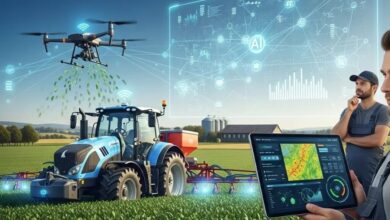
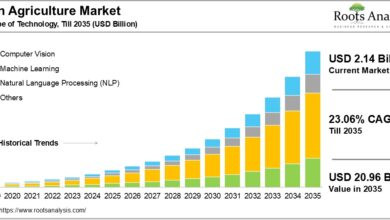
Discover how Artificial Intelligence (AI) is revolutionizing agriculture. Explore market growth, trends, applications, benefits, challenges, and future opportunities shaping the global AI in agriculture industry from 2026 to 2034.

Table of Contents
Introduction: The Rise of AI in Modern Agriculture
Agriculture is undergoing one of the most significant transformations in human history. With the global population projected to reach nearly 10 billion by 2050, the pressure on food production systems has never been greater. At the same time, climate change, shrinking arable land, water scarcity, and rising production costs are forcing farmers and governments to rethink traditional farming methods.
This is where Artificial Intelligence (AI) in agriculture is emerging as a game-changer.
According to recent market analysis and trends , the global AI in agriculture market was valued at approximately USD 1.70 billion in 2025 and is projected to grow to USD 11.95 billion by 2034, expanding at a strong CAGR of 21.0%. This explosive growth highlights how quickly AI is being adopted across farming systems worldwide.
AI is no longer a futuristic concept—it is now a practical tool reshaping how food is grown, monitored, and distributed.
What Trends Artificial Intelligence in Agriculture?
Artificial Intelligence in agriculture refers to the use of advanced technologies such as:
- Machine learning algorithms
- Computer vision systems
- Predictive analytics
- Robotics and automation
- IoT-based smart sensors
These technologies work together to improve decision-making in farming and optimize agricultural productivity.
AI in agriculture supports key farming operations such as:
- Crop monitoring
- Soil health analysis
- Yield prediction
- Pest and disease detection
- Smart irrigation systems
- Livestock monitoring
- Supply chain optimization
Essentially, AI enables “smart farming” where decisions are based on real-time data rather than guesswork.
𝐀𝐥𝐬𝐨 𝐑𝐞𝐚𝐝 : https://www.datadriveharvest.com/2026/04/27/agricultural-intelligence/#google_vignette
Global AI in Agriculture Market Overview
The AI in agriculture market is expanding rapidly due to increasing demand for food, rising adoption of precision farming, and technological advancements in digital agriculture tools.
Key market insights include:
- Market size (2025): USD 1.70 billion
- Projected size (2034): USD 11.95 billion
- CAGR: 21.0%
- Strong adoption across North America, Europe, and Asia-Pacific
Major technology companies such as IBM, Microsoft, John Deere, and Bayer are investing heavily in agricultural AI solutions, further accelerating market growth.
The industry is shifting from traditional farming to data-driven agriculture, where every decision is backed by analytics and automation.
Key Drivers of AI in Agriculture Growth
1. Rising Global Food Demand
One of the strongest drivers of AI adoption is the increasing global demand for food. With population growth expected to reach nearly 9.7 billion by 2050, food production must increase by up to 70%.
AI helps farmers produce more food using fewer resources through:
- Precision farming
- Automated irrigation
- Crop optimization systems
This makes AI essential for global food security.
2. Climate Change and Environmental Pressure
Climate change is creating unpredictable weather patterns, droughts, and floods that directly impact crop yields.
AI helps farmers adapt by:
- Predicting weather patterns
- Identifying climate risks
- Recommending adaptive farming strategies
This improves resilience and reduces crop failure risks.
3. Advancements in IoT and Smart Sensors
The integration of IoT devices with AI is revolutionizing agriculture.
Smart sensors collect real-time data on:
- Soil moisture
- Temperature
- Nutrient levels
- Crop health
AI systems then analyze this data to provide actionable insights, improving farming efficiency by up to 30% in some cases.
4. Government Support for Smart Agriculture
Many governments are investing in trends smart agriculture initiatives to improve food security and sustainability.
Support includes:
- Subsidies for smart farming tools
- Digital agriculture policies
- Funding for AgTech startups
This is especially strong in regions like North America, Europe, and Asia-Pacific.
5. Labor Shortages in Agriculture
The agriculture sector is facing a major labor shortage globally.
AI-powered automation helps solve this problem through:
- Autonomous tractors
- Robotic harvesters
- Automated weed control systems
These technologies reduce dependency on manual labor while improving efficiency.
𝐉𝐨𝐢𝐧 𝐎𝐮𝐫 𝐖𝐡𝐚𝐭𝐬𝐀𝐩𝐩 𝐆𝐫𝐨𝐮𝐩 𝐟𝐨𝐫 𝐌𝐨𝐫𝐞 𝐔𝐩𝐝𝐚𝐭𝐞𝐬
Major Applications of AI trends in Agriculture
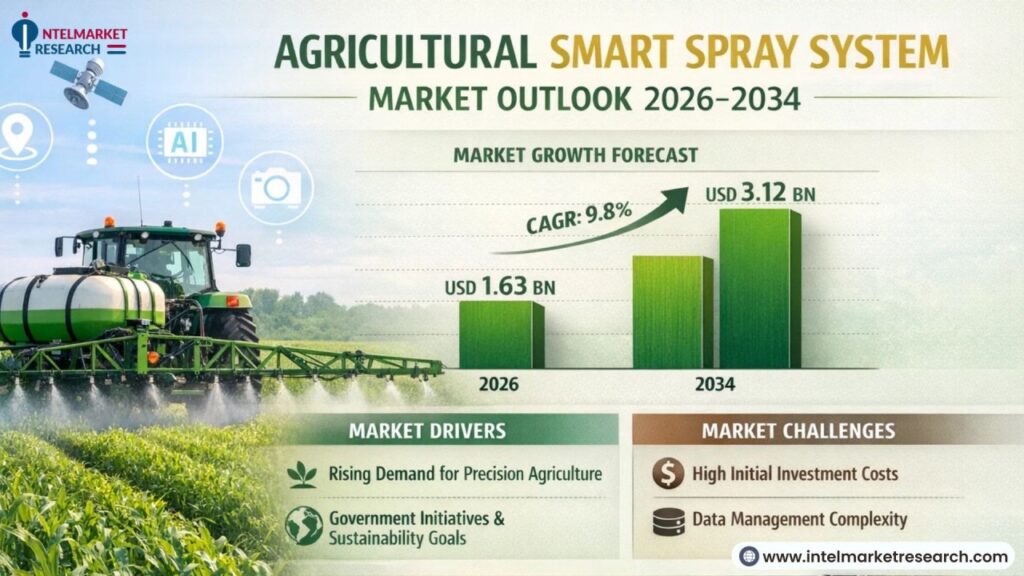
1. Precision Farming
Precision farming is the most widely adopted AI application in agriculture.
It uses GPS, drones, and AI analytics to:
- Monitor crop health
- Optimize fertilizer use
- Improve irrigation efficiency
This leads to higher yields and reduced production costs.
2. Crop Monitoring and Disease Detection
AI-powered trends in computer vision systems can detect crop diseases early by analyzing images from drones or satellites.
Benefits include:
- Early disease detection
- Reduced pesticide usage
- Improved crop survival rates
3. Yield Prediction
Machine learning models analyze historical and real-time data to predict crop yields.
This helps farmers:
- Plan harvest cycles
- Manage supply chains
- Reduce waste
4. Smart Irrigation Systems
AI-based irrigation systems monitor soil conditions and weather forecasts to determine when and how much to water crops.
This results in:
- Water conservation
- Improved crop quality
- Lower operational costs
5. Livestock Monitoring
AI is also used in animal farming through:
- Facial recognition for livestock
- Health monitoring systems
- Behavioral analysis
This improves animal welfare and productivity.
6. Agricultural Robotics
AI-powered robots are increasingly used for:
- Planting seeds
- Harvesting crops
- Removing weeds
This reduces human labor while increasing precision and speed.
𝐀𝐥𝐬𝐨 𝐑𝐞𝐚𝐝 : https://www.datadriveharvest.com/2026/04/13/farming-that-fixes-the-land/#google_vignette
Market Challenges Facing AI trends in Agriculture
Despite its rapid growth, the AI agriculture market faces several challenges.
1. High Implementation Costs
AI technologies require:
- Expensive sensors
- Drones and robotics
- Software platforms
This makes adoption difficult for small-scale farmers.
2. Lack of Technical Skills
Many farmers lack the technical knowledge needed to operate AI systems.
Only a small percentage of farmers currently have data analytics expertise.
3. Poor Rural Connectivity
AI systems rely on internet connectivity and cloud computing.
However, many rural farming areas still lack:
- Reliable internet
- Digital infrastructure
This limits AI deployment.
4. Data Privacy Concerns
Farmers are often concerned about:
- Data ownership
- Security of farm data
- Misuse of agricultural information
Clear regulations are still needed.
Regional Market Insights And Trends
North America
North America leads the AI agriculture market due to:
- Advanced technology adoption
- Strong AgTech ecosystem
- Large-scale commercial farming
Europe
Europe focuses on:
- Sustainable agriculture
- Environmental protection
- Smart farming policies
Asia-Pacific
Asia-Pacific is expected to grow rapidly due to:
- Large agricultural population
- Government digital farming initiatives
- Increasing food demand
Africa (Emerging Opportunity)
Africa has huge potential for AI agriculture due to:
- Expanding population
- Need for food security
- Growing interest in AgTech innovation
Future Trends in AI Agriculture (2026–2034)
1. Fully Autonomous Farming
Future farms will rely heavily on autonomous machines that can plant, monitor, and harvest crops without human intervention.
2. AI-Powered Climate Farming
AI will help farmers predict and adapt to climate change more accurately.
3. Blockchain + AI Integration
This will improve:
- Food traceability
- Supply chain transparency
- Agricultural data security
4. Satellite-Based Farming Intelligence
AI combined with satellite imaging will allow global monitoring of crops in real time.
5. Smart Greenhouses
AI-controlled greenhouses will optimize:
- Temperature
- Humidity
- Light exposure
This enables year-round farming.
Benefits of AI in Agriculture
- Increased crop yields
- Reduced farming costs
- Efficient resource usage
- Improved food security
- Climate adaptation
- Reduced environmental impact
- Better decision-making
AI is not just improving agriculture—it is redefining it.
Conclusion: The trends of Farming is Intelligent
The AI in agriculture market is entering a period of rapid transformation. With strong growth projections reaching nearly USD 12 billion by 2034, AI is becoming a core pillar of global food production systems.
From precision farming and smart irrigation to robotics and predictive analytics, AI is helping farmers produce more food with fewer resources while protecting the environment.
As technology continues to evolve, agriculture will become more intelligent, automated, and sustainable.
The future of farming is no longer manual—it is digital, data-driven, and powered by artificial intelligence.