Discover why agriculture remains the backbone of Southern Africa’s economy in 2026. Learn how innovation, youth participation, technology, and investment can transform food security and create millions of jobs across the region.

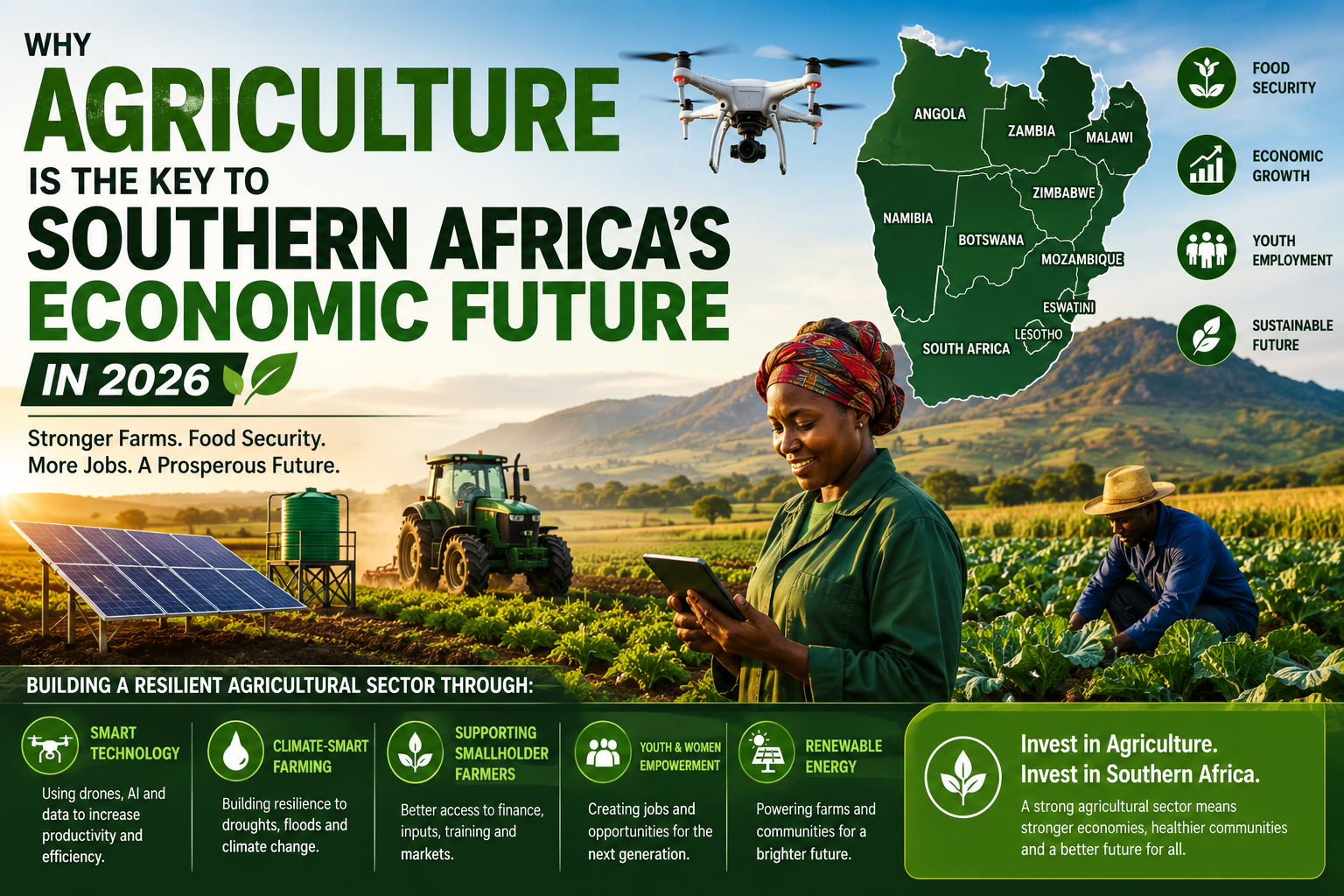
Table of Contents
Southern Africa’s Greatest Opportunity Is Growing in Its Fields
When most people think about the future of Southern Africa, they often imagine technology hubs, mining projects, or booming cities. Yet one of the region’s biggest opportunities is much closer to home—its farms.
Across Southern Africa, agriculture continues to support millions of livelihoods. From maize farms in Zimbabwe and Zambia to livestock operations in Botswana and Namibia, agriculture remains one of the region’s most important economic sectors.
Despite its importance, agriculture is often overlooked as a driver of innovation, job creation, and economic growth. Yet experts increasingly agree that the future prosperity of Southern Africa will depend heavily on how effectively the region transforms its agricultural sector. Agriculture employs more than half of Africa’s workforce and remains the primary source of income for millions of rural households.
As climate challenges intensify and food demand rises, investing in modern, productive, and sustainable agriculture has never been more important.
The Food Security Challenge Facing Southern Africa
Southern Africa continues to face significant food security challenges.
Recurring droughts, floods, cyclones, rising input costs, and economic instability have placed enormous pressure on farmers. Many countries remain vulnerable to food shortages despite having vast agricultural potential.
Climate-related shocks have repeatedly reduced crop yields across parts of Africa, exposing the vulnerability of farming systems that depend heavily on rainfall. Much of African agriculture remains small-scale, low-technology, and rain-fed, making it especially susceptible to weather disruptions.
For countries such as Zimbabwe, Malawi, Mozambique, and Zambia, improving agricultural productivity is not just about increasing production. It is about strengthening national food security and reducing dependence on imports.
Why Smallholder Farmers Matter More Than Ever
The backbone of Southern African agriculture is the smallholder farmer.
Across the continent, an estimated 33 million smallholder farms produce food and support millions of families. These farmers play a critical role in feeding communities, creating jobs, and sustaining rural economies.
Yet many smallholder farmers continue to face major obstacles:
- Limited access to financing
- Poor infrastructure
- Inadequate irrigation systems
- Limited access to technology
- Rising fertilizer costs
- Climate-related risks
Supporting smallholder farmers represents one of the fastest ways to improve food production and reduce rural poverty.
When small farmers become more productive, entire communities benefit.
The Rise of Smart Farming in Southern Africa
Technology is beginning to change the agricultural landscape across Southern Africa.
Farmers are increasingly adopting:
- Precision agriculture
- Smart irrigation systems
- Agricultural drones
- Artificial intelligence
- Mobile farming applications
- Satellite monitoring tools
These technologies allow farmers to make better decisions using real-time data.
Instead of guessing when to irrigate, fertilize, or harvest, farmers can now rely on digital tools that improve efficiency and reduce waste.
This shift toward smart farming is helping producers become more resilient in the face of climate change and rising production costs.
𝐉𝐨𝐢𝐧 𝐎𝐮𝐫 𝐖𝐡𝐚𝐭𝐬𝐀𝐩𝐩 𝐆𝐫𝐨𝐮𝐩 𝐟𝐨𝐫 𝐌𝐨𝐫𝐞 𝐔𝐩𝐝𝐚𝐭𝐞𝐬
Agriculture Can Solve Southern Africa’s Youth Employment Crisis
One of the region’s biggest challenges is youth unemployment.
Every year, millions of young Africans enter the labor market searching for opportunities. Traditional employment sectors often struggle to absorb this growing workforce.
Agriculture offers a solution—but only if it evolves.
For decades, many young people viewed farming as a last-resort occupation. Today, the emergence of Agritech, agricultural entrepreneurship, food processing, logistics, and digital agriculture is changing that perception. Agriculture remains one of the largest potential sources of employment for young Africans if supported by investment, innovation, infrastructure, and skills development.
New opportunities are emerging in:
- Agricultural technology
- Farm management
- Agribusiness consulting
- Food processing
- Supply chain management
- Agricultural finance
- Drone operations
- Agricultural data analysis
For young professionals across Southern Africa, agriculture is becoming one of the most exciting growth industries.
Why Investment in Agriculture Is Critical
Despite agriculture’s importance, investment levels remain below what is needed to unlock the sector’s full potential.
Experts argue that greater investment is needed in:
Irrigation Infrastructure
Reducing dependence on rainfall can significantly improve crop productivity and resilience.
Rural Roads
Better transportation networks help farmers access markets and reduce post-harvest losses.
Agricultural Research
Innovation drives productivity growth and helps farmers adapt to changing conditions.
Digital Technologies
Expanding digital connectivity can improve access to information, financial services, and market opportunities.
Countries that prioritize agricultural investment today are likely to experience stronger economic growth tomorrow.
𝐀𝐥𝐬𝐨 𝐑𝐞𝐚𝐝 : https://www.datadriveharvest.com/2026/04/22/ai-in-agriculture-3/
The Renewable Energy Opportunity for Farmers
Energy access remains a challenge in many rural areas across Southern Africa.
Fortunately, renewable energy technologies are creating new opportunities.
Solar-powered irrigation systems, solar cold storage facilities, and biogas projects are helping farmers reduce costs while improving productivity.
Renewable energy can:
- Reduce reliance on expensive fuel
- Improve irrigation capacity
- Support food processing activities
- Increase profitability
- Strengthen climate resilience
The combination of agriculture and renewable energy could become one of Southern Africa’s most powerful economic growth engines over the next decade.
Climate-Smart Agriculture Is No Longer Optional
Climate change is already affecting farming communities throughout Southern Africa.
Farmers are experiencing:
- Longer drought periods
- Unpredictable rainfall
- Increased pest outbreaks
- Higher temperatures
- Soil degradation
To remain productive, agricultural systems must adapt.
Climate-smart agriculture focuses on:
- Sustainable land management
- Water conservation
- Drought-resistant crops
- Efficient resource use
- Improved soil health
Experts increasingly recognize sustainable land management as a key pathway toward food security, environmental protection, and long-term agricultural growth.
𝐀𝐥𝐬𝐨 𝐑𝐞𝐚𝐝 : https://www.datadriveharvest.com/2026/05/06/trends/
Building a Stronger Agricultural Future for Southern Africa
Southern Africa possesses many advantages:
- Vast agricultural land
- Growing markets
- Young populations
- Expanding digital connectivity
- Increasing investor interest
The challenge is transforming these advantages into lasting economic opportunities.
Governments, development institutions, private investors, agribusinesses, and farmers must work together to modernize agricultural systems and unlock the region’s full potential.
The future of agriculture is no longer just about growing crops. It is about creating jobs, building businesses, strengthening food systems, and driving economic transformation.
Final Thoughts
Agriculture remains one of Southern Africa’s greatest opportunities for sustainable economic growth.
By investing in technology, supporting smallholder farmers, promoting youth participation, expanding renewable energy, and embracing climate-smart agriculture, the region can build a stronger and more resilient future.
The farms of Southern Africa have the potential to feed communities, create millions of jobs, and power economic development for decades to come.
The question is not whether agriculture can transform Southern Africa.
The question is whether the region is ready to invest in its most important resource.