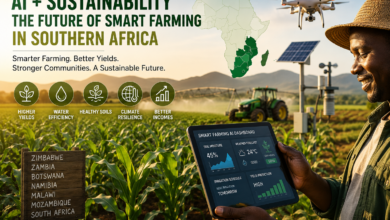
Discover how artificial intelligence is transforming agriculture through smart farming, crop monitoring, disease detection, and precision agriculture. Learn how Southern African farmers can benefit from AI-powered farming 2026.

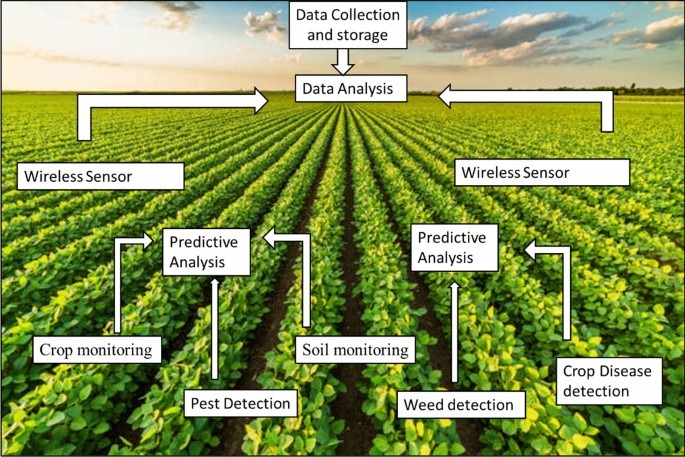
Table of Contents
AI in Agriculture 2026: How Artificial Intelligence Is Helping Crop monitoring Farmers Grow More Food Sustainably
Crop monitoring in Agriculture has always depended on experience, hard work, and careful planning. Today, farmers have another powerful tool at their disposal—artificial intelligence (AI). From predicting crop diseases to monitoring soil conditions and automating farm operations, AI is helping farmers make smarter decisions while improving productivity and sustainability.
Recent research shows that AI is becoming an essential part of modern agriculture, enabling farmers to analyse large amounts of data, optimise resources, and respond more effectively to climate-related challenges. While adoption is growing rapidly in developed countries, the technology also presents significant opportunities for smallholder farmers in Africa when supported by digital infrastructure, training, and affordable tools.
For Southern Africa, where farming is the backbone of many economies, AI could play a key role in improving food security, increasing yields, and building resilience against climate change.
What Is Crop monitoring and AI in Agriculture?
Artificial intelligence in agriculture refers to the use of computer systems that can analyse data, recognise patterns, and make recommendations to support farming activities in crop monitoring.
Instead of relying solely on manual observation, farmers can now use AI-powered systems to monitor crops, predict weather patterns, identify pests, detect plant diseases, and manage irrigation more efficiently.
These technologies help farmers make faster and more accurate decisions, reducing waste while increasing productivity.
How AI Is Changing Modern Farming
AI is transforming agriculture in several practical ways.
Precision Farming
Precision farming allows farmers to apply water, fertiliser, and pesticides only where they are needed.
Using data from satellites, drones, sensors, and AI algorithms, farmers can identify differences across their fields and manage each section individually.
This approach reduces input costs while improving crop performance.
Early Crop monitoring on Disease Detection
One of AI’s biggest advantages is its ability to detect crop diseases before they become widespread.
Machine learning models analyse images captured by smartphones, drones, or cameras to identify symptoms that may not yet be visible to the human eye.
Early detection helps farmers act quickly, reducing crop losses and protecting yields.
Smarter Irrigation
Water is becoming an increasingly scarce resource across Southern Africa.
AI-powered irrigation systems analyse soil moisture, weather forecasts, and crop requirements to determine exactly when and how much water should be applied.
This helps conserve water while ensuring crops receive the moisture they need.
Predicting Crop Yields
AI can combine weather data, soil conditions, historical yields, and crop health information to estimate harvest outcomes.
These predictions help farmers plan storage, transport, marketing, and financial decisions well before harvest.
AI Is Supporting Sustainable Agriculture
One of the most important contributions of AI is its ability to promote sustainable farming.
By improving resource efficiency, AI helps reduce:
- Water waste
- Excess fertiliser use
- Unnecessary pesticide applications
- Fuel consumption
- Greenhouse gas emissions
Researchers believe AI will become increasingly important as agriculture adapts to climate change while meeting growing global food demand.
𝐉𝐨𝐢𝐧 𝐎𝐮𝐫 𝐖𝐡𝐚𝐭𝐬𝐀𝐩𝐩 𝐆𝐫𝐨𝐮𝐩 𝐟𝐨𝐫 𝐌𝐨𝐫𝐞 𝐔𝐩𝐝𝐚𝐭𝐞𝐬
What This Means for Southern Africa
Southern Africa faces several agricultural challenges, including:
- Frequent droughts
- Crop monitoring
- Rising production costs
- Pest outbreaks
- Climate variability
- Limited access to agricultural advisory services
AI can help farmers overcome many of these obstacles through affordable digital solutions.
For example, AI-powered mobile applications can provide:
- Weather forecasts
- Pest and disease identification
- Crop management advice
- Fertiliser recommendations
- Market price information
- Plant health diagnosis using smartphone photos
As internet access and smartphone use continue to expand across the region, these technologies are becoming more accessible to smallholder farmers.
Challenges Slowing AI Adoption
Despite its promise, AI adoption still faces several barriers.
Some of the biggest challenges include:
- Limited internet connectivity
- High cost of digital technologies
- Lack of technical training
- Limited access to quality agricultural data
- Digital literacy gaps
- Infrastructure constraints
Researchers emphasise that addressing these challenges will require investment in connectivity, education, farmer training, and supportive policies.
The Future of AI in Farming
The future of agriculture will increasingly combine artificial intelligence with technologies such as:
- Drones
- Internet of Things (IoT) sensors
- crop monitoring
- Satellite monitoring
- Agricultural robots
- Autonomous tractors
- Smart irrigation systems
- Predictive analytics
Together, these innovations will help farmers make faster, data-driven decisions while reducing costs and improving sustainability.
Experts also expect generative AI and conversational assistants to become valuable tools for agricultural extension, making expert advice more accessible to farmers in remote areas.
Why Farmers Should Start Preparing Today
AI is no longer a technology reserved for large commercial farms.
Many affordable tools are already available through mobile applications, cloud-based platforms, and digital advisory services.
Farmers who begin learning about these technologies today will be better positioned to improve productivity, manage risks, and compete in an increasingly digital agricultural sector.
Even small changes, such as using AI-powered weather forecasts or crop monitoring apps, can lead to significant long-term benefits.
Final Thoughts
Artificial intelligence is transforming agriculture by helping farmers in crop monitoring , production of more food with fewer resources.
From precision farming and disease detection to smart irrigation and predictive analytics, AI is making agriculture more efficient, resilient, and sustainable.
For Southern Africa, these innovations present an opportunity to strengthen food security, improve farm incomes, and build resilience against climate change. As digital tools become more affordable and widely available, AI has the potential to empower farmers of all sizes—not by replacing their knowledge, but by helping them make better-informed decisions every day.
Disclaimer
DataDriveHarvest is an independent agricultural information platform that publishes educational content, research summaries, and technology insights for informational purposes only. This article is based on publicly available academic research and industry sources.